

What Is The Chemical Makeup Of Sweat
| Perspiration | |
|---|---|
| Other names | Sweating, hidrosis, diaphoresis |
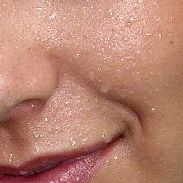 | |
| Droplets of perspiration on the peel | |
| Specialty | Dermatology |
| Symptoms | Torso odor |
| Complications | Dehydration |
| Causes | Fever Heat Hyperthermia |
| Prevention | Drinking h2o |
| Treatment | Antiperspirant |
Perspiration, also known equally sweating, is the production of fluids secreted by the sweat glands in the skin of mammals.[1]
Two types of sweat glands can exist found in humans: eccrine glands and apocrine glands.[two] The eccrine sweat glands are distributed over much of the body and are responsible for secreting the watery, brackish sweat nearly frequently triggered past excessive trunk temperature. The apocrine sweat glands are restricted to the armpits and a few other areas of the body and produce an odorless, oily, opaque secretion which then gains its characteristic odor from bacterial decomposition.
In humans, sweating is primarily a means of thermoregulation, which is achieved by the h2o-rich secretion of the eccrine glands. Maximum sweat rates of an developed tin can be up to two–4 liters per hr or 10–14 liters per day (ten–15 g/min·mii), just is less in children prior to puberty.[three] [4] [5] Evaporation of sweat from the skin surface has a cooling outcome due to evaporative cooling. Hence, in hot weather, or when the individual's muscles heat upwards due to exertion, more than sweat is produced. Animals with few sweat glands, such as dogs, accomplish like temperature regulation results past panting, which evaporates water from the moist lining of the oral fissure and pharynx.
Although sweating is found in a wide variety of mammals,[half-dozen] [7] relatively few (exceptions include humans and horses) produce large amounts of sweat in order to cool down.[8] [ix]
Etymology [edit]
1610s, "a breathing through," a sense at present obsolete, from French perspiration (1560s), noun of activity from perspirer "perspire," from Latin perspirare "accident or breathe constantly," from per "through" (from PIE root *per- (1) "frontward," hence "through") + spirare "to breathe, accident" (see spirit (due north.)). Applied by 1620s to "excretion of invisible moistures through the skin," hence its later use every bit a euphemism for "sweat" (1725).
Definitions [edit]
- The words diaphoresis and hidrosis both can mean either perspiration (in which sense they are synonymous with sweating)[ten] [eleven] or excessive perspiration (in which sense they can be either synonymous with hyperhidrosis or differentiable from it only past clinical criteria involved in narrow specialist senses of the words).
- Hypohidrosis is decreased sweating from whatever cause.[12]
- Focal hyperhidrosis is increased or excessive sweating in certain regions such every bit the underarm, palms, soles, confront, or groin.
- Hyperhidrosis is excessive sweating, commonly secondary to an underlying status (in which case it is called secondary hyperhidrosis) and usually involving the body as a whole (in which case it is called generalized hyperhidrosis).[12]
- Hidromeiosis is a reduction in sweating that is due to blockages of sweat glands in humid weather.[thirteen]
- A substance or medicine that causes perspiration is a sudorific or sudatory.
Signs and symptoms [edit]
Sweat contributes to torso odor when information technology is metabolized by bacteria on the skin. Medications that are used for other treatments and diet also affect odor. Some medical weather, such every bit kidney failure and diabetic ketoacidosis, can besides affect sweat odor. Areas that produce excessive sweat usually appear pink or white, but, in severe cases, may announced cracked, scaly, and soft.[14]
Causes [edit]
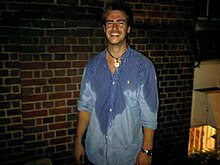
A human being in a sweat-drenched shirt, after some physical exertion.
Diaphoresis is a non-specific symptom or sign, which means that information technology has many possible causes. Some causes of diaphoresis include physical exertion, menopause, fever, ingestion of toxins or irritants, and high ecology temperature. Potent emotions (anger, fear, feet) and remember of by trauma tin can also trigger sweating.[ citation needed ]
The vast majority of sweat glands in the trunk are innervated by sympathetic cholinergic neurons.[xv] Sympathetic postganglionic neurons typically secrete norepinephrine and are named sympathetic adrenergic neurons; however, the sympathetic postganglionic neurons that innervate sweat glands secrete acetylcholine and hence are termed sympathetic cholinergic neurons. Sweat glands, piloerector muscles, and some claret vessels are innervated by sympathetic cholinergic neurons.
Pathological sweating [edit]
Diaphoresis may be associated with some abnormal conditions, such equally hyperthyroidism and stupor. If information technology is accompanied by unexplained weight loss or fever or by palpitations, shortness of breath, or chest discomfort, it suggests serious illness.
Diaphoresis is as well seen in an acute myocardial infarction (heart assault), from the increased firing of the sympathetic nervous system, and is frequent in serotonin syndrome. Diaphoresis can also be acquired by many types of infections, often accompanied by fever and/or chills. Nigh infections can cause some caste of diaphoresis and it is a very common symptom in some serious infections such as malaria and tuberculosis. In addition, pneumothorax tin cause diaphoresis with splinting of the chest wall. Neuroleptic malignant syndrome and other malignant diseases (e.one thousand. leukemias) tin can besides cause diaphoresis.[16]
Diabetics relying on insulin shots or oral medications may have low blood sugar (hypoglycemia), which can also cause diaphoresis.
Drugs (including caffeine, morphine, alcohol, antidepressants and certain antipsychotics) may be causes, as well every bit withdrawal from booze, benzodiazepines, nonbenzodiazepines or narcotic painkiller dependencies. Sympathetic nervous system stimulants such as cocaine and amphetamines have besides been associated with diaphoresis. Diaphoresis due to ectopic catecholamine is a archetype symptom of a pheochromocytoma, a rare tumor of the adrenal gland. Acetylcholinesterase inhibitors (e.thousand. some insecticides) too cause contraction of sweat gland smooth muscle leading to diaphoresis. Mercury is well known for its apply as a diaphoretic, and was widely used in the 19th and early on 20th century by physicians to "purge" the trunk of an disease. Nonetheless, due to the high toxicity of mercury, secondary symptoms would manifest, which were erroneously attributed to the one-time disease that was being treated with mercurials.
Infantile acrodynia (childhood mercury poisoning) is characterized by excessive perspiration. A clinician should immediately consider acrodynia in an afebrile kid who is sweating profusely.
Some people can develop a sweat allergy.[17] [18] The allergy is not due to the sweat itself merely instead to an allergy-producing protein secreted by bacteria constitute on the skin.[19] Tannic-acrid has been found to suppress the allergic response along with showering.[17]
Hyperhidrosis [edit]
In some people, the body's mechanism for cooling itself is overactive—so overactive that they may sweat four or five times more than than is typical.[20] Millions of people are affected past this condition, but more than one-half never receive treatment due to embarrassment, lack of awareness, or lack of concern. While it about commonly affects the armpits, anxiety, and hands, it is possible for someone to experience this condition over their whole body. The face up is some other common area for hyperhidrosis to exist an result. Sweating uncontrollably is not always expected and may be embarrassing to sufferers of the condition. It can cause both physiological and emotional bug in patients. It is generally an inherited problem that is establish in each ethnic group. It is non life-threatening, but it is threatening to a person's quality of life.[21] Treatments for hyperhidrosis include antiperspirants, iontophoresis, and surgical removal of sweat glands. In severe cases, botulinum toxin injections or surgical cutting of nerves that stimulate the excessive sweating (Endoscopic thoracic sympathectomy) may be an selection.[22]
Night sweats [edit]
Dark sweats, besides known every bit nocturnal hyperhidrosis, is the occurrence of excessive sweating during slumber. The person may or may not as well perspire excessively while awake.
I of the most common causes of night sweats in women over 40 is the hormonal changes related to menopause and perimenopause. This is a very mutual occurrence during the menopausal transition years.
While nighttime sweats might exist relatively harmless, it can also be a sign of a serious underlying illness. It is important to distinguish night sweats due to medical causes from those that occur simply because the sleep environs is besides warm, either because the bedchamber is unusually hot or because at that place are also many covers on the bed. Night sweats caused by a medical condition or infection tin be described every bit "severe hot flashes occurring at nighttime that can drench sleepwear and sheets, which are non related to the environment". Some of the underlying medical conditions and infections that cause these severe nighttime sweats tin be life-threatening and should promptly be investigated by a medical practitioner.
Mechanism [edit]

The evaporation of sweat on the skin cools the body.
Sweating allows the body to regulate its temperature. Sweating is controlled from a center in the preoptic and inductive regions of the brain'due south hypothalamus, where thermosensitive neurons are located. The heat-regulatory role of the hypothalamus is also affected by inputs from temperature receptors in the pare. High skin temperature reduces the hypothalamic fix point for sweating and increases the gain of the hypothalamic feedback arrangement in response to variations in cadre temperature. Overall, nonetheless, the sweating response to a rise in hypothalamic ('core') temperature is much larger than the response to the aforementioned increment in average skin temperature.
Sweating causes a subtract in core temperature through evaporative cooling at the peel surface. Every bit loftier energy molecules evaporate from the skin, releasing energy captivated from the trunk, the skin and superficial vessels decrease in temperature. Cooled venous blood then returns to the body'south core and counteracts rise core temperatures.
There are two situations in which the nerves will stimulate the sweat glands, causing perspiration: during concrete oestrus and during emotional stress. In general, emotionally induced sweating is restricted to palms, soles, armpits, and sometimes the brow, while physical oestrus-induced sweating occurs throughout the trunk.[23]
People take an boilerplate of two to iv million sweat glands, but how much sweat is released by each gland is determined by many factors, including sexual activity, genetics, ecology conditions, age and fitness level. 2 of the major contributors to sweat rate are an individual's fitness level and weight. If an private weighs more, sweat rate is likely to increase because the torso must exert more than free energy to role and in that location is more body mass to cool downwardly. On the other hand, a fit person will start sweating before and more readily. Every bit someone becomes fit, the torso becomes more efficient at regulating the body's temperature and sweat glands adapt forth with the torso's other systems.[24]
Sweat is not pure water; it always contains a small amount (0.two–1%) of solute. When a person moves from a cold climate to a hot climate, adaptive changes occur in the sweating mechanisms of the person. This process is referred to equally acclimatization: the maximum charge per unit of sweating increases and its solute composition decreases. The volume of h2o lost in sweat daily is highly variable, ranging from 100 to 8,000 mL/day. The solute loss can be as much as 350 mmol/d (or 90 mmol/d acclimatised) of sodium under the most extreme conditions. During average intensity exercise, sweat losses can average up to 2 litres of water/hour. In a cool climate and in the absenteeism of exercise, sodium loss tin be very low (less than 5 mmol/d). Sodium concentration in sweat is xxx–65 mmol/l, depending on the degree of acclimatisation.
Limerick [edit]

Sweat is mostly water. A microfluidic model of the eccrine sweat gland provides details on what solutes sectionalization into sweat, their mechanisms of partitioning, and their fluidic transport to the peel surface.[25] Dissolved in the water are trace amounts of minerals, lactic acid, and urea. Although the mineral content varies, some measured concentrations are: sodium (0.9 gram/liter), potassium (0.2 g/L), calcium (0.015 g/L), and magnesium (0.0013 grand/Fifty).[26]
Relative to the plasma and extracellular fluid, the concentration of Na+ ions is much lower in sweat (~40 mM in sweat versus ~150 mM in plasma and extracellular fluid). Initially, within eccrine glands sweat has a high concentration of Na+ ions. In the sweat ducts, the Na+ ions are re-absorbed into tissue by epithelial sodium channels (ENaC) that are located on the apical membrane of epithelial cells that course the duct (run across Fig. nine of the reference).[2]
Many other trace elements are as well excreted in sweat, again an indication of their concentration is (although measurements can vary fifteenfold) zinc (0.4 milligrams/liter), copper (0.3–0.8 mg/l), iron (1 mg/50), chromium (0.1 mg/l), nickel (0.05 mg/l), and lead (0.05 mg/l).[27] [28] Probably many other less-abundant trace minerals leave the body through sweating with correspondingly lower concentrations. Some exogenous organic compounds make their way into sweat as exemplified past an unidentified odiferous "maple syrup" scented compound in several of the species in the mushroom genus Lactarius.[29] In humans, sweat is hypoosmotic relative to plasma[30] (i.e. less concentrated). Sweat is found at moderately acidic to neutral pH levels, typically betwixt 4.5 and 7.0.[31]
Gild and culture [edit]
Artificial perspiration [edit]
Artificial skin capable of sweating similar to natural sweat rates and with the surface texture and wetting properties of regular peel has been developed for inquiry purposes.[32] [33] Artificial perspiration is too available for in-vitro testing, and contains 19 amino acids and the near abundant minerals and metabolites in sweat.[ citation needed ]
Diagnostics [edit]
There is interest in its apply in clothing technology. Sweat can be sampled and sensed non-invasively and continuously using electronic tattoos, bands, or patches.[34] However, sweat every bit a diagnostic fluid presents numerous challenges likewise, such as very modest sample volumes and filtration (dilution) of larger-sized hydrophilic analytes. Currently the only major commercial application for sweat diagnostics is for infant cystic fibrosis testing based on sweat chloride concentrations.
See also [edit]
- Apocrine
- Body odor
- Deodorant
- Hidradenitis suppurativa
- Hyperthermia
- Hyponatremia
- Pheromones
- Sweat diagnostics
- Sauna suit
- Transpiration
References [edit]
- ^ Mosher HH (1933). "Simultaneous Study of Constituents of Urine and Perspiration" (PDF). The Journal of Biological Chemistry. 99 (three): 781–790. doi:ten.1016/S0021-9258(xviii)76026-2.
- ^ a b Hanukoglu I, Boggula VR, Vaknine H, Sharma S, Kleyman T, Hanukoglu A (January 2017). "Expression of epithelial sodium channel (ENaC) and CFTR in the human epidermis and epidermal appendages". Histochemistry and Cell Biology. 147 (6): 733–748. doi:x.1007/s00418-016-1535-3. PMID 28130590. S2CID 8504408.
- ^ Jessen, C. (2000). Temperature Regulation in Humans and Other Mammals. Berlin: Springer. ISBN978-three-540-41234-two.
- ^ Mack, G. W.; Nadel, East. R. (1996). "Torso fluid residuum during rut stress in humans". In Fregly, G. J.; Blatteis, C. M. (eds.). Handbook of Physiology. Section 4: Environmental Physiology. New York: Oxford University Press. pp. 187–214. ISBN978-0-19-507492-5.
- ^ Sawka, Yard. L.; Wenger, C. B.; Pandolf, K. B. (1996). "Thermoregulatory responses to acute exercise-heat stress and oestrus acclimation". In Fregly, M. J.; Blatteis, C. M. (eds.). Handbook of Physiology. Section four: Environmental Physiology. New York: Oxford University Press. ISBN978-0-19-507492-5.
- ^ Goglia G (Jan 1953). "[Farther inquiry on the branched sweat glands in some mammals (Cavia cobaya, Sus scrofa, Equus caballus).]". Bollettino della Società Italiana di Biologia Sperimentale. 29 (one): 58–60. PMID 13066656.
- ^ Robertshaw D, Taylor CR (November 1969). "Sweat gland function of the donkey (Equus asinus)". The Journal of Physiology. 205 (ane): 79–89. doi:ten.1113/jphysiol.1969.sp008952. PMC1348626. PMID 5347721.
- ^ McDonald RE, Fleming RI, Beeley JG, et al. (2009). Koutsopoulos S (ed.). "Latherin: A Surfactant Protein of Equus caballus Sweat and Saliva". PLOS ONE. 4 (5): e5726. Bibcode:2009PLoSO...4.5726M. doi:10.1371/periodical.pone.0005726. PMC2684629. PMID 19478940.
- ^ Jenkinson, D. McEwan (April 1973). "Comparative Physiology of Sweating". British Periodical of Dermatology. 88 (four): 397–406. doi:10.1111/j.1365-2133.1973.tb07573.x. PMID 4582049. S2CID 35727313.
- ^ Elsevier, Dorland'southward Illustrated Medical Lexicon, Elsevier.
- ^ Wolters Kluwer, Stedman's Medical Lexicon, Wolters Kluwer.
- ^ a b "Academy of Hyperhidrosis". Allaboutsweat.com. Archived from the original on 2018-12-27. Retrieved 2014-04-05 .
- ^ Parsons K (2009). "Maintaining health, comfort and productivity in rut waves". Glob Wellness Action. two: 2057. doi:ten.3402/gha.v2i0.2057. PMC2799322. PMID 20052377.
- ^ Excessive Sweating Data on Healthline.com, Retrieved on 2010-01-25.
- ^ Boron, Walter F., and Emile L. Boulpaep. "Sweating." Medical Physiology. Updated 2nd ed. Philadelphia: Elsevier, 2012. 1260-264. Print.
- ^ Neuroleptic Malignant Syndrome~clinical at eMedicine
- ^ a b Hiragun, Takaaki; Hiragun, Makiko; Ishii, Kaori; Kan, Takanobu; Hide, Michihiro (July 2017). "Sweat allergy: Extrinsic or intrinsic?". Journal of Dermatological Science. 87 (1): 3–nine. doi:10.1016/j.jdermsci.2017.03.002. PMID 28416076.
- ^ Hiragun, Takaaki; Hide, Michihiro (2016). Sweat Allergy. Perspiration Research. Current Issues in Dermatology. Vol. 51. pp. 101–108. doi:10.1159/000446788. ISBN978-3-318-05904-5. PMID 27584969.
- ^ Yokozeki, Hiroo (2016). Perspiration research. Basel New York: Karger. p. 52. ISBN9783318059052.
- ^ International Hyperhidrosis Social club: About Hyperhidrosis Archived 2015-09-07 at the Wayback Car, Retrieved on 2010-01-25.
- ^ Kamudoni, P.; Mueller, B.; Halford, J.; Schouveller, A.; Stacey, B.; Salek, One thousand.S. (8 June 2017). "The affect of hyperhidrosis on patients' daily life and quality of life: a qualitative investigation". Wellness and Quality of Life Outcomes. 15 (1): 121. doi:10.1186/s12955-017-0693-x. ISSN 1477-7525. PMC5465471. PMID 28595584.
- ^ "Hyperhidrosis: MedlinePlus Medical Encyclopedia". medlineplus.gov . Retrieved 21 Dec 2019.
- ^ Kameia, Tomoya; Tsudab, Takao; Kitagawab, Shinya; Naitoha, Ken; Nakashimaa, Koji; Ohhashi, Toshio (June 1998). "Physical stimuli and emotional stress-induced sweat secretions in the human palm and brow". Analytica Chimica Acta. 365 (1–3): 319–326. doi:10.1016/S0003-2670(97)00642-ix.
- ^ Hansen, Julieann. "The Science of Sweat". American College of Sports Medicine. Archived from the original on 2013-09-21. Retrieved nineteen September 2013.
- ^ Sonner, Z.; Wilder, E.; Heikenfeld, J.; Kasting, Thou.; Beyette, F.; Swaile, D.; Sherman, F.; Joyce, J.; Hagen, J. (2015-05-01). "The microfluidics of the eccrine sweat gland, including biomarker partitioning, transport, and biosensing implications". Biomicrofluidics. 9 (3): 031301. doi:x.1063/i.4921039. ISSN 1932-1058. PMC4433483. PMID 26045728.
- ^ Montain, S. J.; Cheuvront, South. N.; Lukaski, H. C. (2007). "Sweat mineral-chemical element responses during 7 h of exercise-rut stress". International Periodical of Sport Nutrition and Exercise Metabolism. 17 (6): 574–582. doi:10.1123/ijsnem.17.6.574. PMID 18156662. S2CID 3030692.
- ^ Cohn JR, Emmett EA (1978). "The excretion of traces of metals in human sweat". Register of Clinical and Laboratory Science. viii (4): 270–v. PMID 686643.
- ^ Saraymen, Recep; Kılıç, Eser; Yazar, Süleyman (2004). "Sweat Copper, Zinc, Atomic number 26, Magnesium and Chromium Levels in National Wrestler". İnönü Üniversitesi Tıp Fakültesi Dergisi. eleven (one): seven–x. Archived from the original on 2011-08-20.
- ^ Aurora, David "Lactarius fragilis" Mushrooms Demystified 1986 Ten Speed Press, Berkeley California
- ^ Constanzo, Linda S. BRS Physiology (sixth ed.). p. 151.
- ^ Bandodkar AJ, Hung VW, Jia W, Ramirez GV, Windmiller JR, Martinez AG, Ramirez J, Chan K, Kagan K, Wang J (2013). "Tattoo-based potentiometric ion-selective sensors for epidermal pH monitoring". Analyst. 138 (1): 123–eight. Bibcode:2013Ana...138..123B. doi:ten.1039/c2an36422k. PMID 23113321.
- ^ Hou, Linlin; Hagen, Joshua; Wang, Xiao; Papautsky, Ian; Naik, Rajesh; Kelley-Loughnane, Nancy; Heikenfeld, Jason (2013-04-23). "Artificial microfluidic skin for in vitro perspiration simulation and testing". Lab on a Chip. 13 (x): 1868–1875. doi:ten.1039/C3LC41231H. PMID 23576120.
- ^ Jain, Vaibhav; Ochoa, Manuel; Jiang, Hongjie; Rahimi, Rahim; Ziaie, Babak (2019-06-17). "A mass-customizable dermal patch with detached colorimetric indicators for personalized sweat rate quantification". Microsystems & Nanoengineering. 5 (1): 29. Bibcode:2019MicNa...5...29J. doi:10.1038/s41378-019-0067-0. ISSN 2055-7434. PMC6572848. PMID 31240108.
- ^ Heikenfeld, Jason (2016). "Non-invasive Analyte Access and Sensing through Eccrine Sweat: Challenges and Outlook circa 2016". Electroanalysis. 28 (6): 1242–1249. doi:x.1002/elan.201600018.
Farther reading [edit]
- Ferner South, Koszmagk R, Lehmann A, Heilmann Westward (1990). "[Reference values of Na(+) and Cl(-) concentrations in adult sweat]". Zeitschrift für Erkrankungen der Atmungsorgane (in German language). 175 (ii): 70–v. PMID 2264363.
- Nadel ER, Bullard RW, Stolwijk JA (July 1971). "Importance of peel temperature in the regulation of sweating". Journal of Applied Physiology. 31 (1): 80–7. doi:x.1152/jappl.1971.31.ane.80. PMID 5556967.
- Sato K, Kang WH, Saga K, Sato KT (April 1989). "Biology of sweat glands and their disorders. I. Normal sweat gland function". Journal of the American University of Dermatology. 20 (4): 537–63. doi:x.1016/S0190-9622(89)70063-3. PMID 2654204.
External links [edit]
-
 Media related to Perspiration at Wikimedia Commons
Source: https://en.wikipedia.org/wiki/Perspiration#:~:text=Dissolved%20in%20the%20water%20are,(0.0013%20g%2FL).
Posted by: bevilacquathisitted.blogspot.com
0 Response to "What Is The Chemical Makeup Of Sweat"
Post a Comment